Trying to make sense of prediction markets can leave you lost in a flood of charts, data, and fast-moving trends. Without a clear approach, even sharp traders miss valuable insights and overlook market opportunities. You need strategies that help you organize information, make smarter automated decisions, and manage risk—without hours of manual effort or advanced coding skills.
The good news is that new methods let you combine market data blocks, set up conditional rules, and use visual tools for risk management. Techniques proven in quantitative research now help you uncover patterns that professionals rely on to stay ahead.
Get ready to discover practical ways to harness organized chunks of information and modern tools for sharper prediction market trading. These insights will help you pull order from chaos, act with confidence, and upgrade your trading results.
Table of Contents
- 1. Using Market Data Blocks for Trend Analysis
- 2. Setting Conditional Logic for Automated Decisions
- 3. Managing Risk with No-Code Visual Tools
- 4. AI-Assisted Strategy Generation for Fresh Ideas
- 5. Copy Trading Top Wallets for Improved Performance
- 6. Backtesting and Paper Trading Your Strategies
Quick Summary
| Takeaway | Explanation |
|---|---|
| 1. Organize market data into blocks | Grouping data helps identify trading trends faster and improve decision-making. Use volume, time-series, and sentiment blocks for clarity. |
| 2. Implement conditional logic for trades | Use "if-then" rules to automate trading based on set conditions, improving speed and reducing emotional mistakes. |
| 3. Utilize visual tools for risk management | No-code visual tools help clarify risk exposure and enforce discipline, automatically stopping trades at preset loss limits. |
| 4. Leverage AI for strategy generation | AI generates and tests trading strategies quickly, giving you fresh ideas and validation without extensive research time. |
| 5. Backtest and paper trade extensively | Always test strategies through backtesting and simulations to build confidence and validate effectiveness before trading live. |
1. Using Market Data Blocks for Trend Analysis
Market data blocks are organized chunks of information that help you identify where prices are heading. Instead of staring at endless data points, you group similar information together to spot patterns faster and make smarter trading decisions.
When you structure market data into meaningful blocks, you can see emerging trends clearly. Data clustering and trend identification techniques help traders extract actionable signals from raw market information. This approach mirrors how professional analysts digest massive datasets to forecast market movements.
Your prediction market trading improves when you organize data strategically:
- Volume blocks show when interest is concentrating in specific price ranges
- Time-series blocks reveal how momentum builds or weakens over different periods
- Sentiment blocks capture shifts in trader positioning and confidence
- Volatility blocks highlight when markets are calm versus turbulent
Think of it like organizing your kitchen by meal type rather than alphabetically. You'll find ingredients faster and cook better meals. The same applies to market analysis—grouping related data makes patterns jump out instantly.
Organizing market data into blocks transforms overwhelming datasets into actionable trend signals that drive profitable trading decisions.
Here's how to implement this in your trading workflow. Start by pulling historical price data for your target markets, then segment it by time periods (hourly, daily, weekly blocks). Next, identify what volume and momentum looked like in each block, then compare current market behavior to these historical blocks. When current action matches previous patterns, you've found your edge.
Many successful traders use visual strategy builders to automate this block-based analysis. You can connect data retrieval blocks, organize them logically, and let your system continuously scan for matching patterns without manual checking.
Pro tip: Start with 3-5 key market data blocks (price, volume, open interest) rather than overcomplicating your setup—focused analysis beats scattered data points every single time.
2. Setting Conditional Logic for Automated Decisions
Conditional logic is the "if-then" rules that tell your trading system when to act. Without these rules, your strategy trades randomly. With them, your system makes calculated decisions based on real market conditions.
Think of conditional logic as your trading blueprint. You set up statements like "if price breaks above resistance AND volume spikes, then execute a buy." Your automated system continuously monitors these conditions and acts instantly when all criteria align.
Conditional prediction markets use underlying logic to connect market prices directly to outcomes. This same principle applies to your trading automation—structured conditions transform price data into actionable signals.
Here are the essential conditional types for prediction market traders:
- Price conditions trigger when markets hit specific levels or breakpoints
- Volume conditions activate when trading interest reaches thresholds
- Time conditions execute orders at predetermined moments or intervals
- Probability conditions fire when calculated odds cross your target ranges
- Multiple conditions require several factors to align before execution
Why does this matter? Manual traders miss opportunities constantly. They're checking charts when the signal appears, then hesitating before acting. Automated conditional logic executes instantly when your rules are met, giving you competitive speed.
Conditional logic transforms your trading intuition into automated rules that execute consistently without emotion or delays.
Implementing conditional logic starts simple. Define your entry conditions clearly (what must happen for you to buy), then your exit conditions (when you should sell). Next, specify any risk management conditions like stop losses or position size limits based on market volatility.
Your no-code strategy builder lets you stack these conditions visually. Connect a data block that monitors price, add a logic block that evaluates your conditions, then attach an action block that executes your trade. The system runs 24/7 without you watching screens.
Complex trading decisions benefit most from layered conditions. Instead of one simple rule, you might combine price action, momentum, and volume signals. This reduces false signals and improves your win rate significantly.
Pro tip: Start with 2-3 core conditions rather than a dozen fragmented rules—simpler logic generates fewer errors and performs better under real market stress.
3. Managing Risk with No-Code Visual Tools
Risk management stops traders from blowing up their accounts. Visual tools make this process concrete and actionable instead of abstract and ignored. You can see your exposure at a glance rather than calculating it mentally while stressed.
Traditional risk management requires spreadsheets, calculations, and manual monitoring. You track position sizes, calculate loss limits, monitor correlations. It's tedious, error-prone, and easy to skip when markets move fast. No-code visual tools automate this entirely.
Visual risk representations like dashboards and heat maps communicate complex risk information clearly. Instead of staring at numbers, you see immediate visual warnings when exposure gets dangerous. Red zones appear instantly when your losses approach limits.
Your trading system can monitor these key risk elements automatically:
- Position sizing scales orders based on current account equity and volatility
- Stop loss levels execute automatically when losses hit your preset threshold
- Correlation risks alert you when multiple positions move together unexpectedly
- Drawdown limits prevent trading after losing a specific percentage of capital
- Daily loss caps stop all trading once you've lost enough that day
No-code platforms let you build these controls without writing code. You connect a position block to a risk calculation block, then attach decision blocks that execute exits when conditions trigger. Your strategy enforces discipline automatically.
Why does this transform your results? Emotional traders abandon their risk rules when they're losing. They convince themselves "just one more trade" or "it will bounce back." Visual tools remove emotion. When your system shows red and stops trading, you stop trading. Period.
Visual risk controls transform emotional trading decisions into objective, automated rules that protect your capital consistently.
Implementing visual risk management takes minutes, not hours. Set your maximum daily loss, define your position size formula, and establish your stop loss distances. No-code and low-code platforms provide accessible risk controls that non-technical traders can configure independently.
Start with your most important risk parameter—maximum loss per day. Build that rule first, test it in paper trading, then add position sizing rules. Layer in correlation monitoring last once you're comfortable with the basics.
Pro tip: Always set your risk parameters BEFORE you start trading live—never adjust them mid-drawdown when emotions are high and judgment is impaired.
4. AI-Assisted Strategy Generation for Fresh Ideas
Artificial intelligence generates trading strategies you might never think of alone. Instead of recycling the same patterns you've used for years, AI explores thousands of combinations and surfaces viable ideas instantly. You get fresh perspectives without spending weeks on research.
Traditional strategy development is slow. You read articles, study historical charts, backtest manually, then debate whether your idea works. By the time you finish, market conditions have shifted. AI accelerates this process dramatically by testing multiple scenarios simultaneously.
Generative AI supports rapid exploration of strategic options that rival human-level formulation. You describe what you're trying to achieve, and AI suggests specific rule combinations that fit your goals. It's like having a research team working 24/7 for you.
AI strategy generation helps you in several concrete ways:
- Pattern discovery identifies correlations in market data you'd miss manually
- Idea acceleration compresses weeks of research into minutes
- Novelty generation produces unconventional strategies worth testing
- Scenario testing simulates how ideas perform across different market conditions
- Risk optimization suggests entry and exit rules that balance profit and protection
The key insight is that AI doesn't replace your judgment—it augments it. You still decide which generated ideas to test and implement. AI removes the tedious exploration phase, letting you focus on evaluation and refinement.
AI-generated strategies give you fresh trading ideas validated by data, not just intuition or habit.
Here's how to use this in practice. Start by defining your trading goal clearly. "I want to identify trend reversals in volatile markets" is specific enough for AI. The system generates multiple rule combinations, each with backtested performance data. You review results, pick the top 3 candidates, and paper trade them.
AI scenario generation produces diverse future scenarios with minimal human input. This means you can test how your generated strategies perform under bull markets, bear markets, choppy sideways action, and black swan events. You see weaknesses before risking real capital.
Many traders get stuck in pattern ruts. They repeat the same approach because it's familiar, not because it's optimal. AI breaks you free from that mental trap by presenting alternatives systematically.
Pro tip: Always backtest AI-generated strategies across multiple market environments and time periods—don't deploy ideas based on a single favorable result.
5. Copy Trading Top Wallets for Improved Performance
Copy trading lets you replicate trades from successful Polymarket traders automatically. Instead of generating your own ideas, you mirror the decisions of proven winners. It's like having a professional trader execute positions for you while you sleep.
Why would you copy instead of trade independently? Successful traders have already solved the hard problems. They know which markets to focus on, when sentiment is shifting, and how to size positions for profit. Learning from their real trades accelerates your growth dramatically.
Copy trading increases exposure to strategies with proven positive outcomes, though traders must manage risk carefully. You're not blindly following anyone—you choose which wallets to copy based on their track record and strategy style.
Here's what makes copy trading valuable for your trading:
- Time savings eliminates hours spent analyzing markets and generating ideas
- Proven strategies copies trades from wallets with documented winning records
- Risk learning shows you how expert traders size positions and manage drawdowns
- Diversification lets you copy multiple wallets with different market specialties
- Emotion removal automates execution so you don't hesitate or override decisions
The mechanics are straightforward. You identify top-performing wallets by reviewing their historical returns, win rate, and maximum drawdowns. Then you set how much capital to allocate to copying each wallet. The system automatically mirrors their trades proportionally to your account size.
Copying expert traders transforms you from guessing about markets into following proven decision-makers.
Implementing copy trading requires two decisions. First, choose which wallets to copy based on their actual performance history, not marketing claims. Second, decide how much capital to allocate to each wallet. Conservative traders might copy three wallets with 25 percent allocated to each, leaving 25 percent for personal trading.
Automated copy trading bots adjust positions based on your risk preferences and capital allocation automatically. You're not locked into static positions. As your account grows, copied positions scale up proportionally. If you reduce capital allocation, positions shrink automatically.
One critical insight: copy trading teaches you through observation. You watch how expert traders respond to momentum shifts, how they exit losing positions, when they double down. Over time, you absorb their decision-making patterns and develop your own edge.
Pro tip: Copy only wallets with at least 3-6 months of documented performance history during varied market conditions, not just bull markets.
6. Backtesting and Paper Trading Your Strategies
Backtesting and paper trading are your safety nets before risking real money. Backtesting runs your strategy against historical data to see how it would have performed. Paper trading simulates live markets without actual capital at risk. Together, they answer the critical question: "Does this strategy actually work?"
Most traders skip this step and lose money quickly. They have an idea that feels good, deploy it live, and watch it fail spectacularly. You avoid that trap by proving your strategy works first through rigorous testing.
Backtesting evaluates trading rules on historical data to assess potential risk and return before actual trading. You simulate thousands of trades over different market conditions and timeframes. This reveals whether your edge is real or just lucky.
Your testing should cover these critical aspects:
- Multiple market conditions include bull runs, crashes, sideways consolidation, and volatility spikes
- Different timeframes show whether your strategy works across hours, days, or weeks
- Win rate analysis measures what percentage of trades are profitable
- Drawdown testing reveals maximum losses you'll endure during normal operation
- Parameter optimization adjusts your rules to improve historical performance
Backtesting reveals patterns you missed. You might discover your strategy crushes trending markets but fails in choppy ones. Or it excels with specific market pairs but struggles elsewhere. This knowledge lets you deploy selectively, not blindly everywhere.
Testing strategies before trading prevents catastrophic losses and builds genuine confidence in your approach.
Paper trading comes next. This uses real-time market data but doesn't execute actual trades. You see exactly how your strategy would perform right now, which is different from historical performance. Market conditions change, so real-time testing matters enormously.
Backtesting and paper trading modules support strategy evaluation on both historical and current market data. You run your strategy in simulation mode, watching it execute trades in real time without risk. After 2-4 weeks of paper trading success, you've earned the right to trade with real capital.
Many professional traders backtest for months and paper trade for weeks before deploying live. This patience pays off dramatically. You enter live trading with genuine confidence, not hope.
Pro tip: Never skip paper trading—backtest results always look better than live performance because real markets have slippage, surprise gaps, and unexpected volatility that historical data can't fully capture.
Below is a comprehensive table summarizing the key topics discussed throughout the article, focusing on advanced trading strategies and methodologies.
Unlock Your Prediction Market Potential with No-Code Strategy Building
The article highlights key challenges traders face such as organizing market data efficiently, setting precise conditional logic, managing risk visually, generating fresh AI-powered strategies, copying expert wallets safely, and rigorously backtesting ideas before trading live. These pain points can slow growth and cause costly mistakes if handled manually or without the right tools. PolyBlocks directly addresses these issues by offering a no-code, visual strategy builder that empowers you to convert complex trading concepts like market data blocks and conditional logic into automated, emotion-free decision systems.
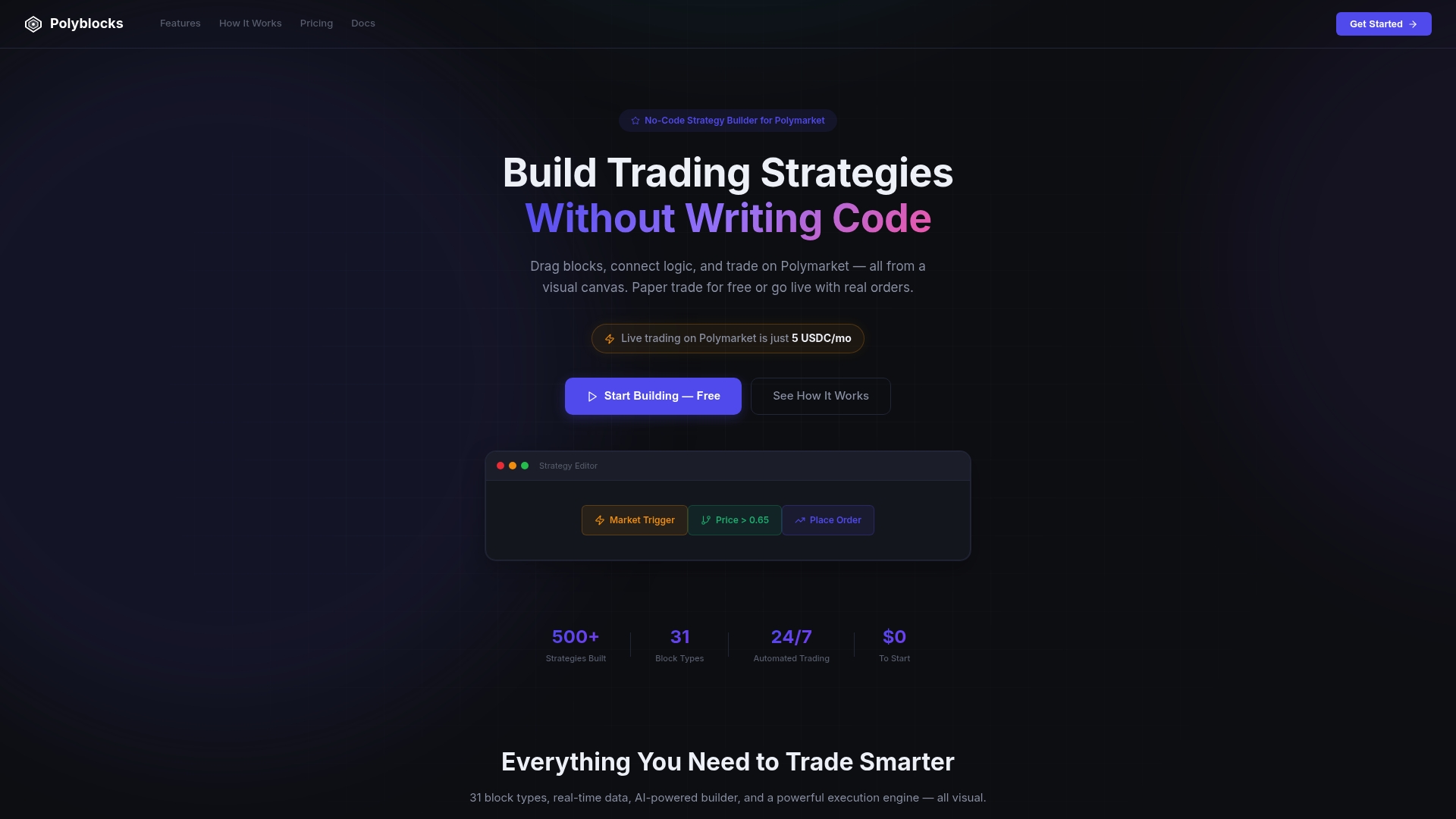
Jumpstart your trading edge today by designing sophisticated algorithms through PolyBlocks' drag-and-drop interface without any programming. Explore features like AI-assisted strategy creation to discover new ideas, real-time paper trading to test before risking capital, and copy trading from top Polymarket wallets to learn from proven winners. Don’t let complicated coding or emotional errors hold you back. Take control, optimize your strategies, and automate your success now at PolyBlocks. Start building smarter trading systems that work for you 24/7.
Frequently Asked Questions
What are market data blocks and how can they improve my trading analysis?
Market data blocks are organized segments of information that help traders identify price trends more quickly. By grouping similar data, such as volume or sentiment, you can spot patterns readily and make more informed decisions. Start by creating a few blocks focused on key metrics to enhance your analysis.
How can I implement conditional logic in my trading strategy?
Conditional logic involves setting up "if-then" rules that dictate when your trading system should take action. For example, you can specify that if the price exceeds a certain level and the volume increases, then a buy order should be executed. Begin by clearly defining your entry and exit conditions to create a structured decision-making process.
What visual tools can I use for risk management in trading?
Visual tools for risk management include dashboards and heat maps that provide a clear view of your exposure without complex calculations. These tools can alert you visually when your risk levels become concerning, helping you manage losses effectively. Utilize these visual aids to monitor your position sizes and stop-loss levels regularly.
How can I use AI to generate new trading strategies?
Artificial intelligence can analyze vast amounts of data to suggest novel trading strategies tailored to your goals. By specifying what you want to achieve, such as identifying trends in volatile markets, AI can provide rule combinations for you to test. Start using AI tools to quickly generate and evaluate multiple strategy ideas, cutting down your research time significantly.
What is copy trading, and how can it help me improve my trading performance?
Copy trading allows you to replicate the trades of successful traders automatically, helping you learn and profit without having to analyze everything yourself. By selecting wallets with proven track records, you can efficiently allocate funds to follow their strategies. Review historical performances and select a few wallets to copy, which can enhance your overall trading skills while minimizing risks.
Why is backtesting important before executing strategies in real markets?
Backtesting is crucial because it allows you to run your trading strategy against historical data to see how well it would have performed. This analysis helps you identify potential weaknesses and gives you confidence in your strategy before risking real money. Perform backtesting over different market conditions to ensure your approach is robust and reliable.